Epoxy-based

Marking Inks

Marking Inks

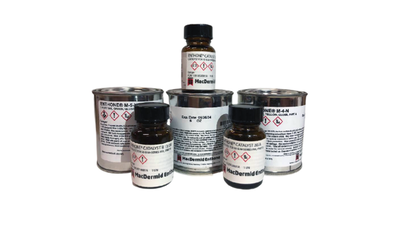
MacDermid Alpha Electronics Solutions offers a comprehensive portfolio of high-performance marking inks engineered specifically for the semiconductor, military, aerospace, and industrial electronics markets. This category currently centers on the ENTHONE® M-Series and ENTHONE® 50-Series Cat L Inks, which are permanent, two-component, epoxy-based ink systems. When properly applied and cured, these inks have excellent adhesion to glass, metal, thermosetting plastics, photoimageable solder masks, and circuit boards

While both series utilize robust epoxy chemistry to deliver high chemical and thermal resistance, they are formulated for different application methods. ENTHONE M-Series inks are specifically formulated for transfer marking, hand stamping, and manual applications. Conversely, ENTHONE 50-Series Cat L Inks are designed for screen printing, spraying, and manual application. Both ink families require a catalyst to cure, enabling flexible processing windows tailored to specific manufacturing environments.

From identifying semiconductor components and printed circuit boards to marking aerospace dials, edge-lit panels, and automotive parts, these inks provide permanent, high-reliability identification. They are RoHS compliant across all product variants and are compatible with Pb-Free assembly processes, with Low Halogen options available in the 50-Series.

2 products

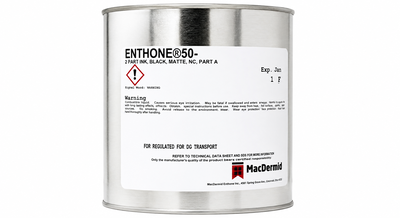
  • ENTHONE 50

    ENTHONE 50 Series

    • Ambient or Heat-Cure Flexibility
    • Multi-Method Permanent Marking
    • Chemical- and Thermal-Resistant Films
  • ENTHONE M Series

    ENTHONE M Series

    • Five-Method Permanent Marking
    • One to 24-Hour Pot-Life Options
    • Humidity-Conditioned Electrical Insulation

Product selector guide

How to select the right Marking Ink & Catalyst?

Selection depends on the required application method, color, and curing constraints:

  • M-Series: Select for stamping or transfer printing.
  • 50-Series: Select for screen printing or spraying.
  • Heat Cure vs Ambient Cure: Catalyst B-3, Catalyst 5, and Catalyst 9 are heat cure only. Catalyst 20/A, B-13/28, and 77 can be cured at room temperature or with heat. Note that inks cured with Catalyst 20/A at room temp will not meet Type II Mil-Spec requirements; heat cure is required.


ENTHONE® Marking Inks

Product Series / Type Color Description RoHS Compliant Notable Features
M-6-N M-Series (Transfer) Blue Yes Approx. Fed-STD-595 ref 15180
M-9-N M-Series (Transfer) White Yes Approx. Fed-STD-595 ref 17925
M-0-N M-Series (Transfer) Black Yes Not intended for electrical applications
M-0-NC M-Series (Transfer) Inorganic Black (Blue Tint) Yes Use Catalyst B-13/28
50-100R 50-Series (Screen) White Yes Low Halogen option available (419 ppm)
50-110RX 50-Series (Screen) White, Matte Yes Recommend Catalyst 9 for anti-yellowing
50-120R 50-Series (Screen) White, High Hide Yes Provides high hiding power
50-400R 50-Series (Screen) Ultramarine Blue Yes Low Halogen option available (633 ppm)
50-403R 50-Series (Screen) Light Blue Yes -
50-700R 50-Series (Screen) Black, Carbon Pigment Yes Low electrical resistance; not for electrical applications
50-710R 50-Series (Screen) Black, Matte Carbon Pigment Yes Low electrical resistance; not for electrical applications
50-770R 50-Series (Screen) Black, Matte Yes High electrical resistance / Nonconductive
50-771R 50-Series (Screen) Black, Gloss Yes High electrical resistance / Nonconductive
50-800R 50-Series (Screen) Clear, Gloss Yes -
50-810R 50-Series (Screen) Clear, Matte Yes -


ENTHONE® Catalyst Options

Catalyst Cure Type Pot Life Description
Catalyst 20/A Ambient / Heat 2 Hours Basic air cure catalyst. Cures at room temperature in 5 to 7 days.
Catalyst B-3 Heat Cure Only 4 Hours Basic heat cure only catalyst. Higher temperatures decrease cure time.
Catalyst 5 Heat Cure Only 24 Hours Max Long pot life, excellent adhesion. Requires special mix ratios.
Catalyst 9 Heat Cure Only 7 Hours Basic heat cure catalyst with good anti-yellowing resistance (recommended for 50-110RX).
Catalyst B-13/28 Ambient / Heat 1 Hour Accelerated air cure catalyst. Cures at room temperature in 3 days.
Catalyst 77 Ambient / Heat 1 Hour Adhesion promoting catalyst. Max adhesion achieved via heat cure at 65.6 to 93.3°C.

Frequently asked questions

Frequently Asked Questions about Marking Inks

What is the difference between ENTHONE® M-Series and 50-Series?

Both are permanent, two-component, epoxy-based marking inks, but they are formulated for different applications. ENTHONE M-Series inks are designed for transfer marking, hand stamping, and manual application. ENTHONE 50-Series Cat L inks are formulated for screen printing, spraying, and manual application.

Why is catalyst selection important for these inks?

The chosen catalyst defines the final material performance. Catalyst selection directly controls the ink's pot life, working time, cure response (room temperature vs. heat cure), and final post-cure properties such as conductivity, outgassing levels, chemical resistance, and moisture resistance.

How long is the pot life once the ink is mixed?

Pot life varies based on the specific catalyst used and can range from 1 to 24 hours. For instance, Catalyst 5 offers the longest pot life at a maximum of 24 hours, while Catalyst 77 and Catalyst B-13/28 offer an average pot life of 1 hour. High ambient temperatures will shorten pot life, and solvent additions will increase it.

Are MacDermid Alpha marking inks RoHS compliant?

Yes. MacDermid Alpha marking inks are RoHS compliant across all product variants and are compatible with Pb-Free assembly processes. Additionally, several inks in the 50-Series have Low Halogen options available.


Learn more

Understanding ENTHONE® Marking Inks

Permanent, two-component epoxy ink systems engineered for high-reliability electronics, aerospace, and semiconductor applications.

Epoxy-Based
Two-Component

What Are ENTHONE® Marking Inks?

ENTHONE M-Series and 50-Series Inks are two-component systems consisting of a pigmented epoxy resin base and a separate catalyst. Both the ink and catalyst must be accurately weighed and thoroughly mixed prior to application. Excessive or insufficient amounts of catalyst are detrimental to the cured ink film properties.

Because they are reactive systems, these inks require an induction period (typically 30 to 60 minutes) after mixing. This allows entrapped air to escape and ensures a homogenous mix before printing.

Once applied via screen printing, spraying, or transfer marking, the inks cure into a highly durable film that resists harsh chemicals, thermal cycling, and environmental degradation.

Catalyst Technology – Key Characteristics
Processing Flexibility
  • Catalyst selection allows pot life adjustment from 1 to 24 hours.
  • Supports short-run and extended-run production by providing greater control over usable working time.
Post-Cure Performance
  • The selected catalyst helps determine the final post-cured material condition.
  • Influences conductivity, electrical resistance, and outgassing levels for sensitive applications.
Environmental Durability
  • Catalyst choice affects how cured ink materials respond to harsh environments.
  • Influences resistance to chemicals, moisture, and anti-yellowing performance over time.
 

Primary Ink Families

Formulated for specific application methods and manufacturing requirements

 
Transfer Marking Stamping

1. ENTHONE® M-Series Inks

ENTHONE M-Series inks are formulated specifically for transfer marking, hand stamping, machine marking, and manual application. Minimum pressure is recommended for transfer-pad or flat-bed printers.

They are ideal for semiconductor component marking, identifying printed circuit boards, and labeling industrial connectors.

 
Screen Printing Spraying

2. ENTHONE® 50-Series Inks

ENTHONE 50-Series Cat L Inks are formulated for screen printing and spraying applications. When screen printing, monofilament polyester or metallized polyester fabrics with a mesh count from 180 to 350 are recommended.

They have excellent adhesion to photoimageable, thermal, and UV solder masks, making them highly suitable for circuit board legend printing.

The Processing & Curing Mechanism

Proper handling is required to ensure strong adhesion and compliance

Stage 1

Mixing & Induction

Measure ink and catalyst accurately by weight. Allow the mixture to stand for 30 minutes (or 60 minutes for Catalyst 5) prior to application. This induction period ensures a homogenous mix and allows entrapped air to escape. Thinners or flow agents must only be added after this period.

Stage 2

Application

The surface must be clean and free of residues to ensure optimum adhesion. For ENIG (Electroless Nickel Immersion Gold) processes on printed wiring boards, ink application must occur after the ENIG process to avoid color change effects during high heat assemblies.

Stage 3

Curing

Inks may be cured at room temperature or elevated temperatures depending on the catalyst. For example, Catalyst B-3 requires heat cure above 79°C (175°F). An extended cure of 30 minutes at 150°C (300°F) will result in low outgassing properties.


Technical Document Preview

View the technical resources directly within the browser or open them in a new tab for a larger view.

 Marking Inks Selector Guide
Enthone Catalysts
 Enthone Products Selector Guide

Leading Brands Trust in Our Products and Services

  • Jabil
  • Linxens
  • Magna
  • Medtronic
  • NXP
  • Philips
  • Semikron
  • Teledyne
  • Thales
  • Vishay
  • ZF
  • AMS
  • Apple
  • Audi
  • Broadcom
  • Borgwarner
  • Bosch
  • Eaton
  • Henkel
  • Honeywell
  • Hysol
  • Intel
Products that Perform|Knowledge that Serves|Service that Delivers